
The Good, The Bad, The Uncertain
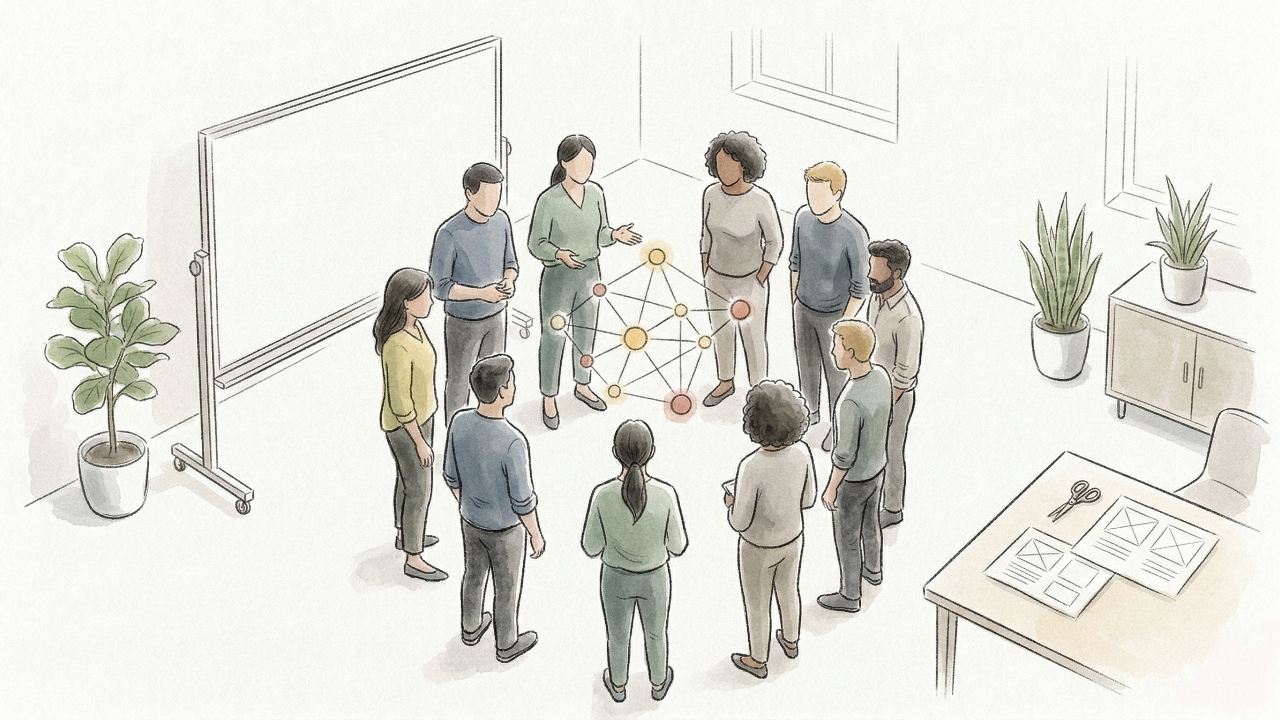
From businesses to hospitals to universities, every organization was designed by humans, including how work would be done, who would do it, how decisions would be made, and how the pieces would fit together to form a cohesive, interdependent system. These organizations, along with modern management, resulted in the astonishing creation of knowledge, wealth, and health beyond anything humans had experienced before. At the same time, the methods and resources used by these organizations also produce unintended side effects, some of which threaten our ability to create wealth and advance our health. Good news: these organizations and their methods were designed by humans and can thus be redesigned to create sustainable value for multiple stakeholders.
The Best of Times
Over the last three centuries, advancements in science, technology, and economic systems have substantially improved many aspects of human life, including wealth, health, and education. The commercialization of science made the first Industrial Revolution possible, fundamentally changing our ability to create wealth (Pinker, 2018). These changes have led to an astonishing increase in the average annual gross domestic product (GDP) per person, from less than $1,200 in 1820 to over $15,000 per person in 2022. Most of that improvement occurred in the last 70 years, since 1950, when GDP was approximately $3,360 per person (Our World in Data, 2025a).
Over the same period, poverty worldwide decreased from over 80% of the population living in extreme poverty to less than 9% today. Again, half of that improvement has occurred in the last 70 years (Our World in Data, 2025b). This has resulted in numerous improvements to our health, including better nutrition, access to clean water and sanitation, reduced child mortality, vaccinations, and increased life expectancy. The average life expectancy has more than doubled over the past century, from 32 years in 1900 to over 73 years in 2023 (Our World in Data, 2025c).
These benefits create a virtuous reinforcing loop: as human capability increases, we learn more about what works and what doesn’t under what conditions, thereby further improving economic growth (Our World in Data, 2025d). Given our modern conveniences, including plumbing, heating, air conditioning, a variety of food options, overnight delivery, transportation, smartphones, etc., many people today live better than kings did 200 years ago. For most people, there has never been a better time to be alive.
Unfortunately, many of the methods we have invented to improve the human condition have also produced unintended side effects, limiting our ability to make further progress or, in some cases, making it difficult even to maintain the gains.
Unfortunately, the progress in reducing extreme poverty has slowed since the pandemic, resulting in millions of people remaining in extreme poverty for decades (World Bank, 2025). In addition, the side effects of our methods and resources used now limit future progress and threaten our ability to sustain the gains.
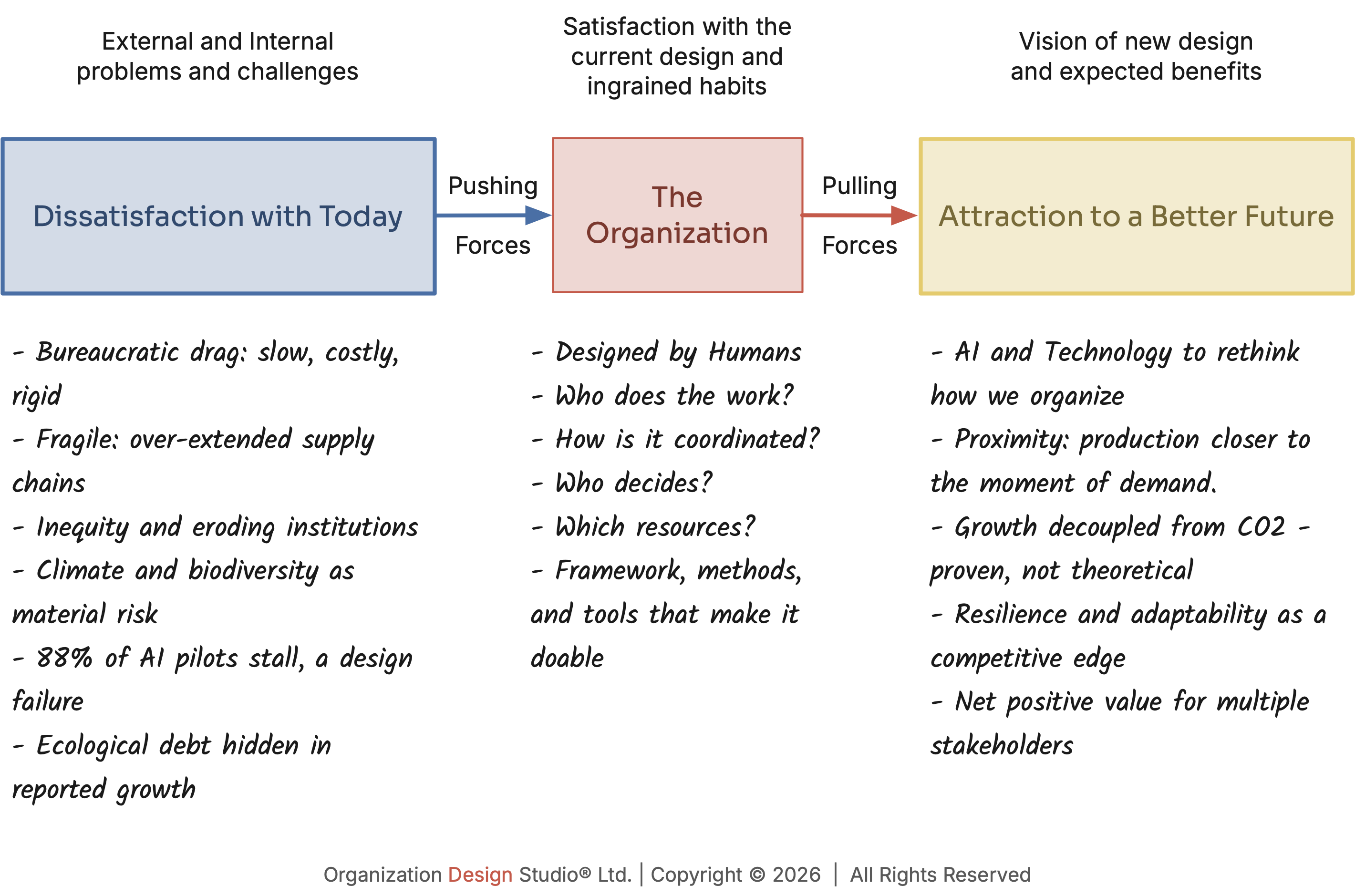
Figure 1 - Forces for Change
Unintended Consequences
Our methods have worked like powerful medicines. They treated the diseases, including poverty, hunger, and early death, but they produced side effects, some of which we are only now diagnosing. The diagnosis is slow for a reason: the distance in time and space between cause and effect hides the connections between our design decisions and their long-term outcomes.
What started as the quest to create rational organizations often led to unnecessarily slow and costly bureaucratic systems, the opposite of what is needed in a rapidly changing and uncertain world. In 2008, the mortgage-finance system in the United States proved unable to identify and correct inherent design flaws, leading to government intervention to avoid total collapse (Latham, 2009). Our approach to global trade has led to long, complex, and fragile supply chains that lack resilience, as evidenced by their performance during the recent COVID-19 pandemic. In addition, economic and human progress have been uneven among countries, creating inequities and tensions that have led to pressures to reform systems and institutions (Hoffman, 2025).
When our ancestors built our industrial, agricultural, and global trade systems, they chose energy sources to power facilities, production, and transportation methods based on practical considerations such as cost, availability, and technical characteristics. The impact of carbon dioxide (CO2) in the atmosphere on climate was seldom, if ever, a factor in decisions. The level of CO2 in the atmosphere passed a global “sustainable” level of 350 parts per million (ppm) around 1988. It is currently over 420 ppm (Our World in Data, 2025e, f). The rate of temperature rise is accelerating, as are the associated costs (Hansen et al. 2025).
Many things that begin with good intentions and innovation often end up creating more problems than they initially solved. Some governments and economies around the world do not account for all the costs of doing business, including environmental and climate-change costs. Consequently, part of the dramatic increase in GDP is overstated because it doesn’t account for the ecological debt that will come due in future generations.
Uncertain Future
Leaders today face rapid, often unpredictable change across every environment at once: political, economic, technological, natural, societal, legal, regulatory, and competitive.
Many of the institutions that once provided a measure of certainty for organizations are now being eroded and destroyed, creating unprecedented uncertainty in countries of all types worldwide. The undoing of old policies and the creation of new ones are changing the rules of the game for many organizations. Economic uncertainty, stemming from changing trade policies, high levels of government debt, and fluctuating exchange rates, makes strategy and decision-making difficult at best and, in many cases, results in paralysis and inaction.
While artificial intelligence (AI) and other technological advances hold immense potential to address challenges in productivity, health, and climate change, among others, they also present numerous Implementation challenges and ethical dilemmas. A recent book titled “ Proximity ” has captured some of the related technological developments in miniaturization, customization, and localization (Wolcott & Krippendorff, 2024). Technological advances offer many opportunities to rethink how we organize and lead people to achieve common goals.
The damage to business, real property, and life due to natural disasters, along with the associated costs of addressing climate change, has created additional material risks for investors and challenges for leaders. These material risks of climate change, biodiversity loss, and other environmental issues also threaten our ability to create wealth. The interrelated nature of these issues underscores the need to continually reinvent our leadership and management methods to capitalize on opportunities and mitigate threats.
The Fastest-Adopted Technology in History
No technology has ever spread as quickly as artificial intelligence. Within three years of its public debut, generative AI reached more than half of the world's population, a pace neither the personal computer nor the internet approached, and 70% report using generative AI in at least one function (Stanford Institute for Human-Centered Artificial Intelligence [Stanford HAI], 2026). Global corporate AI investment more than doubled in 2025 alone (Stanford HAI, 2026). Alongside it, breakthroughs in miniaturization, customization, and localization are compressing production and services ever closer to the moment of demand (Wolcott & Krippendorff, 2024). Whatever else is uncertain about AI, its arrival is not.
Thus far, the results have been mixed, and the failure of AI to improve organizational performance has largely been an organization-design problem, not a model problem. Recent research found that 88% of AI agent pilot projects never reach full deployment, and Gartner’s projection is that over 40% will be canceled by the end of 2027 (Chambers, 2026).
Leaders surveyed in the Deloitte 2026 Global Human Capital Trends report identified “the two most important drivers of success are accelerating how people and resources are orchestrated to perform work and increasing their organization’s and workforce’s ability to adapt to change and speed” (Poynton et al., 2026). The promise of AI depends on re-examining the underlying assumptions behind how and who does things, how and who coordinates the interdependent activities, and how and who makes decisions. What AI will do to your organization, however, is not written in the technology. It is written in the design.
The Design Challenge
Organizations today are often poorly designed, outdated, and ill-prepared to survive, let alone thrive, in the modern environment (Latham, 2013). A key organizational design question becomes: how can we maintain the advances we have made and make even more progress while eliminating or mitigating undesirable and unintended consequences? We have strong evidence that it is possible to redesign our methods to provide the benefits while reducing the unwanted side effects.
When we frame these challenges as trade-offs, the challenges appear impossible: economic growth or climate change, technology or people, efficiency or resilience, shareholders or society. The design challenge is to imagine new methods that dissolve these dilemmas and create value for multiple stakeholders.
Many wealthy countries have demonstrated that we can change our designs to decouple GDP from CO2 emissions (Our World in Data, 2025g). There are numerous examples of organizations redesigning their methods not only to produce less CO2 but also to reduce costs, thereby making a net positive contribution to their bottom line (Polman & Winston, 2021). For example, Interface, a US-based global carpet manufacturer, increased its market share and financial performance while reducing its environmental impact (Anderson, 1998; 2019).
The organization is one of the most significant inventions in human history, enabling large numbers of people to accomplish things that no individual could do alone. According to Harari (2018), our ability to organize and direct the actions of large numbers of humans toward a common purpose and goals is what distinguishes us from all other species. Organizations are the vehicles we use to leverage science, technology, and the economic system to create and capture wealth. The challenge is to design organizations that are profitable, scalable, flexible, and resilient while creating a net positive value for multiple stakeholders. This requires a systems approach based on empirical evidence, imagination, and continuous learning and redesign. The Organization Design Studio® is a support system that provides frameworks, methods, tools, and techniques to help leaders design organizations that thrive today and in the future.
Consciously or unconsciously, we designed our way into every one of these problems. Design is the way out.
References
Anderson, R. C. (1998). Mid-course correction—Toward a sustainable enterprise: The Interface Model. Chelsea Green.
Anderson, R. (with Lanier, J. A., & Hawken, P.). (2019). Mid-Course correction revisited: The story and legacy of a radical industrialist and his quest for authentic change. Chelsea Green Publishing.
Chambers, Z. (2026, July 28). Cognizant launches EMEA AI unit as enterprise agent pilots fail at scale. Tech Times. https://www.techtimes.com/articles/321781/20260728/cognizant-launches-emea-ai-unit-enterprise-agent-pilots-fail-scale.htm
Hansen, J. E., Kharecha, P., Sato, M., Tselioudis, G., Kelly, J., Bauer, S. E., Ruedy, R., Jeong, E., Jin, Q., Rignot, E., Velicogna, I., Schoeberl, M. R., Von Schuckmann, K., Amponsem, J., Cao, J., Keskinen, A., Li, J., & Pokela, A. (2025). Global Warming Has Accelerated: Are the United Nations and the Public Well-Informed? Environment: Science and Policy for Sustainable Development, 67 (1), 6–44. https://doi.org/10.1080/00139157.2025.2434494
Harari, Y. N. (2018). Sapiens: A brief history of humankind (First Harper Perennial edition). Harper Perennial.
Hoffman, A. J. (2025). Business school and the noble purpose of the market: Correcting the systemic failures of shareholder capitalism. Stanford Business Books, an imprint of Stanford University Press.
Latham, J. R. (2013). How much does your organization weigh? Innovation 32(2).
https://drjohnlatham.com/2013/06/01/how-much-does-your-organization-weigh/
Latham, J. R. (2009). Complex system design: Creating sustainable change in the mortgage-finance system. Quality Management Journal, 16(3), 19-25. https://doi.org/10.1080/10686967.2009.11918235
Our World in Data (2025a). World GDP per capita. https://ourworldindata.org/grapher/gdp-per-capita-maddison-project-database?tab=chart&country=~OWID_WRL
Our World in Data (2025b). Share of population living in extreme poverty.
https://ourworldindata.org/grapher/share-of-population-living-in-extreme-poverty-cost-of-basic-needs
Our World in Data (2025c). Life Expectancy.
https://ourworldindata.org/grapher/life-expectancy
Our World in Data (2025d). GDP and Human Development.
https://ourworldindata.org/grapher/human-development-index-vs-gdp-per-capita
Our World in Data (2025e). CO2 Emissions vs. GDP.
https://ourworldindata.org/grapher/co2-emissions-vs-gdp
Our World in Data (2025f). Global atmospheric CO₂ concentration.
https://ourworldindata.org/grapher/global-co2-concentration
Our World in Data (2025g). Decoupling CO2 from GDP.
https://ourworldindata.org/grapher/co2-emissions-and-gdp
Pinker, S. (2018). Enlightenment now: The case for reason, science, humanism, and progress. Penguin Books.
Polman, P., & Winston, A. S. (2021). Net positive: How courageous companies thrive by giving more than they take. Harvard Business Review Press.
Poynton, S., Flynn, J., Scoble-Williams, N., Reyes, V., Mallon, D., & Cantrell, S. (2026). From tensions to tipping points: Choosing the human advantage. Deloitte Insights. https://www.deloitte.com/us/en/insights/topics/talent/human-capital-trends.html
Stanford Institute for Human-Centered Artificial Intelligence. (2026). *Artificial intelligence index report 2026*. Stanford University. https://hai.stanford.edu/ai-index/2026-ai-index-report
Wolcott, R. C., & Krippendorff, K. (2024). Proximity: How coming breakthroughs in just-in-time transform business, society, and daily life. Columbia University Press.
World Bank. (2025, June 5). *June 2025 update to global poverty lines* \[Fact sheet\]. https://www.worldbank.org/en/news/factsheet/2025/06/05/june-2025-update-to-global-poverty-lines
The Design Behind It
Every Result Has One
Monthly notes from the Studio on designing organizations that perform: practices you can use, AI methods that hold up, and evidence weighed for design.
We hate SPAM. We will never sell your information, for any reason.
