Organization Systems
In August of 1950, Dr. W. Edwards Deming presented his concept of production as a system to senior business leaders in Japan (Deming, 1986, p. 4). Since then, numerous attempts have been made to define the organization as a system of interrelated activities and decisions. One notable example is Michael Porter’s Value Chain, which builds on the production chain and incorporates cross-cutting functions such as procurement, technology development, human resource management, and firm infrastructure (Porter, 1985, p. 37). Kaplan and Norton developed a Balanced Scorecard Strategy Map approach, depicting causal relationships among four interrelated perspectives: financial (revenue and productivity), customer (products, relationships, and operational excellence), internal (processes, innovation, and sustainability), and learning and growth (Kaplan and Norton, 2001, p. 96). The design of the activities and decisions that comprise these systems was influenced by Juran’s Trilogy of planning, management, and improvement, which is embedded in the performance excellence models that followed (Juran, 1992).
Organizational Excellence frameworks, such as the European Foundation for Quality Management (EFQM, 2024) and the Malcolm Baldrige National Quality Award (NIST, 2021), emerged in the 1980s and have influenced the development of numerous systems frameworks worldwide. Some organizations have developed their own frameworks, such as the Tata Business Excellence Model in India. Other countries have developed frameworks that align with their national strategy and vision, such as the United Arab Emirates' Sheikh Khalifa Government Excellence Program. Additionally, the African Excellence Forum aligns its framework with the United Nations' Sustainable Development Goals. While the details of each assessment framework are distinct, they all address the planning, management, and improvement of interrelated activities and decision-making common to most organizations. All of these frameworks have proven useful to assess the current design of organizational systems.
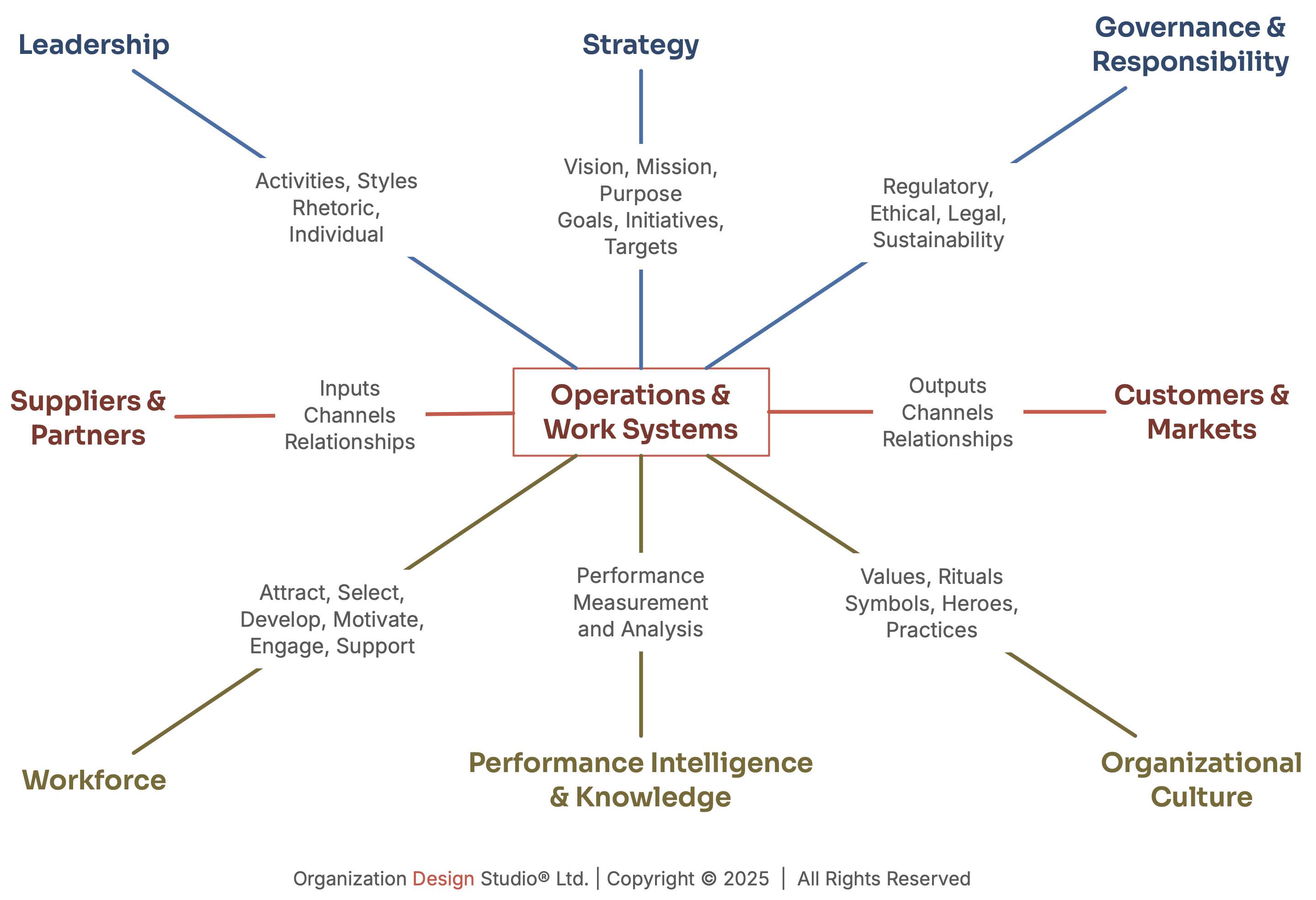
Figure 1 - Organization Systems
Organization Systems
Organizational activities and decisions can be organized into nine interconnected dimensions that comprise a universal systems framework to guide the design of the value-creation, enabler, and guidance systems (Figure 1). The value-creation components include understanding customers and designing products to meet their needs; producing, delivering, and servicing products and services; and managing suppliers and partners. The value creation activities are enabled by an empowered and engaged workforce, the organization’s culture, and scorecards and analyses that provide essential knowledge throughout the organization. In addition, the development and deployment of strategy, governance, and leadership work together to guide activities and decisions throughout the organization.
Well-designed approaches for each of the nine areas are systematic, with the appropriate level of flexibility, consistent with other relevant aspects of the organization (aligned), and operate in a coordinated fashion with different activities and decisions (integrated). Additionally, they continuously evolve to stay relevant in a rapidly changing and uncertain world.
1. Leadership
Leadership is needed to guide the activities and decisions throughout the organization. An explicitly defined approach to leadership helps develop leaders who are aligned with and reinforce the organization's purpose, values, and strategy. Leadership encompasses defined activities, how those activities are carried out, the leaders' style and characteristics, and the rhetoric or messages they convey. At its core, leadership is one person influencing another individual or group by providing direction and an example to emulate.
Leaders face many complex, risk-taking situations that require analysis and decisions for the organization. They also need a flexible approach to handle diverse followers and situations. Consequently, an approach to leadership should provide sufficient structure to help leaders navigate the ambiguity of complex, constantly changing people and contexts without restricting their ability to address the challenges of the day creatively. When embarking on an organization redesign journey, it is often best to begin by designing a custom approach to leadership. This provides leaders with the tools to lead the redesign and transformation of other systems within the organization, thereby increasing their credibility by setting a positive example. Example leadership activities:
- Set Direction: Develop the values, strategies, policies, and expectations that guide people throughout the organization.
- Communication & Role Modeling: Develop and deliver messages that convey the organization's values, purpose, direction, policies, practices, and other key information. Role-model the desired behaviors that are consistent with the organization's values, purpose, strategies, policies, and practices.
- Problem Solving & Crisis Decision-Making: Analyze a variety of complex organizational challenges, crises, and conflicts and decide on the best course of action to address the issue.
- Performance Review & Accountability: Periodically evaluate organizational results and adjust strategies, policies, and practices to improve performance. Review individual performance and hold people accountable for behavior consistent with the organization's values and practices, and for making the necessary changes to achieve the strategy.
- Leadership Learning & Development: Continuously reflect, learn, and develop leadership knowledge, skills, and abilities to stay relevant in an ever-changing and uncertain world.
2. Strategy
Systematic approaches to strategy require just enough structure to support the creative process without unnecessarily constraining strategists’ thinking. Strategy typically begins with analyzing the external environment and competition to identify opportunities for growth and expansion. This opportunity-driven approach differentiates strategy in commercial enterprises from programming found in organizations with a mandated mission and a budget, such as many government organizations and NGOs. Both involve formal plans to communicate the implementation details, but programming follows a mandated mission, and strategy is opportunity-driven and determines how the organization will compete. Commercial strategy is a much more ambiguous and risky activity than planning for a mandated mission.
The internal core competencies, capabilities, and the organization's purpose inform the development of a strategy to address the opportunities. Strategy is a hypothesis about what the leaders believe will lead to the desired customer, market, and financial outcomes. Strategies are typically translated into goals, objectives, and initiatives, along with action plans, to inform resource allocation and decision-making. Progress toward the strategy is reviewed periodically to determine whether the hypothesis was correct or whether adjustments are needed to keep the organization moving toward its vision. Strategy is a continuous learning process of development, deployment, review, and revision. Example strategy activities:
- Vision, Mission, & Purpose: Develop and deploy the organization's vision, mission, and purpose. Periodically evaluate them to ensure they remain current, relevant, and effective.
- Environmental Scanning, Foresight, & Core Competencies: Collect and analyze information on relevant external factors, including political, economic, social, technological, environmental, legal, and competitive trends, and explore scenarios of how those trends might unfold. Assess and analyze the unique internal organizational context and core competencies.
- Strategy Development & Feasibility Testing: Develop strategies to succeed in a dynamic and uncertain environment. Test the feasibility and assess the risks of the proposed strategies, refining them to increase the odds of success.
- Action Planning & Resource Allocation: Identify the specific changes required to implement the strategy, including deliverables, activities, personnel, resources, metrics, and schedule.
- Strategic Initiative & Portfolio Management: Actively manage strategic initiatives to ensure the timely delivery of required deliverables, quality, and performance within allocated resources.
- Strategy Review & Revision: Periodically review progress and performance improvements, making adjustments to the strategy and initiatives as needed.
3. Governance & Responsibility
Governance activities focus on ensuring accountability for, and the protection of, stakeholder interests. While the activities, decisions, and participants involved vary by organization type, industry, and country, governance activities apply to all organizations and contexts. Governance activities include proactively ensuring that all organizational members adhere to ethical, legal, and regulatory requirements in all their actions and decisions. Additionally, it provides methods to address any unethical or illegal behavior and non-compliance with regulations.
Governance also addresses the organization's economic, social, and environmental sustainability across its products, services, operations, supply chain, and workforce. Ideally, governance activities incorporate ways to anticipate stakeholder concerns with current and planned products, services, and operations. Financial responsibility is assessed using methods and personnel independent of those held accountable. Risk assessment and mitigation are critical aspects of ensuring stakeholders are protected. While governance approaches may not directly contribute to the organization's performance, they can help prevent its destruction. Consequently, governance is a vital complement to strategy. Example governance activities:
- Executive Accountability & Governing Body Oversight: Ensure accountability at the top and throughout the organization, including established methods and criteria to assess the performance of senior leaders and the members of the governing body.
- Organizational Communications & Transparency: Select, analyze, and disseminate information to inform decisions, and develop policies for sharing information within and outside the organization.
- Risk Management & Independent Audits: Ensure accurate reporting through independent internal and external audits. Assess and mitigate the risks associated with the organization's operations, products, and services.
- Regulatory Compliance & Ethical Conduct: Comply with current laws and regulations and prepare for those on the horizon. Promote ethical conduct in every decision and transaction, and act decisively when behavior falls short.
- Societal Contribution & Environmental Impact: Anticipate and address the effects of current and planned products, services, and operations on society and the natural environment. Go beyond preventing harm to identify ways the organization can strengthen the communities and ecosystems on which it depends.
4. Customers & Markets
The purpose of an organization, or any system within it, is to produce outputs for its external customers or for the next internal operation. A systematic approach to current and potential customers begins with methods to capture and understand their needs, wants, and desires. Analysis of their requirements enables the organization to segment customers into groups with similar needs and identify the factors influencing satisfaction, purchase decisions, and referrals. These factors are used to proactively design and develop products and services, manage customer relationships, and identify communication and delivery channels that meet customers' needs.
A systematic customer complaint management process is used to resolve unexpected issues. The complaints are then aggregated and analyzed to develop solutions to prevent future occurrences. A comprehensive customer system includes measuring product and service quality and performance that predict customer satisfaction, as well as customers’ perceptions and behavior. The insights from systematic customer approaches inform strategy, guide workforce development, and support the planning, management, and improvement of operations that produce and deliver the products and services. Example customer activities:
- Customer Segmentation & Listening: Identify target customer groups, including current and potential customers, as well as competitors' customers.
- Customer & Market Insight: Understand the needs, expectations, and preferences that lead customers to buy, return, and recommend the organization to others.
- Product/Service Design & Development: Translate customer and market insights into product and service offerings, features, and functions. Develop and test new and improved products, services, and customer experiences.
- Channels, Sales, & Distribution Pathways: Establish the pathways to deliver the products and services, including communication methods, distribution, sales, and support.
- Relationship Building & Customer Experience: Build relationships with customers by engaging with and supporting them throughout their product and service experiences.
- Complaint Management & Resolution: Resolve customer complaints and aggregate complaint data to identify solutions that prevent similar complaints.
- Satisfaction & Engagement Measurement: Determine how satisfied customers are with the products and services, including perceptions, behavior, and comparisons.
5. Operations & Work Systems
Operations and production systems include the essential production and support activities and decisions that create and deliver products and services to meet customers’ needs. Effective operations begin with a systematic approach to planning and organizing production and delivery activities. Operations are designed and managed to meet the unique needs of the organization and its operating environment. In-process metrics are tracked to ensure that operations produce the necessary outputs to meet customer needs.
Support activities are designed and managed to serve operations and production activities. Each activity in the organization either serves the external customer or an internal customer, creating a chain of internal customer-supplier relationships that eventually serve the external customer. This approach is often referred to as “next operation as customer.”
Systematic problem-solving methods are incorporated into the system to address unexpected issues and minimize downtime. The operations system's overall effectiveness, efficiency, alignment, and integration are regularly assessed from multiple perspectives and refined to improve performance. The operations system transforms inputs from suppliers and partners and thus depends on high-performing ones. Example operations activities:
- Work System & Process Design: Design and develop the system of work processes to produce the products and services.
- Operational Forecasting, Planning, & Scheduling: Forecast, plan, and schedule work activities; identify needed materials and assign people.
- Day-to-Day Process Management: Ensure that day-to-day operations meet or exceed internal and external customer requirements, using in-process metrics to proactively manage work processes, customer experiences, and end-product quality and performance.
- Project Management (Custom Solutions): Manage unique work for custom solutions for internal and external customers.
- Operational Problem Solving & Incident Response: Solve problems that arise during recurring work activities and special projects.
- Emergency Readiness & Continuity: Plan, prepare, and practice for emergencies, disasters, and other disruptions, so the organization can protect its people, sustain critical operations, and recover quickly.
6. Suppliers & Partners
Many organizations rely on the performance of suppliers and partners to deliver the necessary inputs for creating high-quality solutions for their customers. Based on the organization's strategy and core competencies, the approach to suppliers and partners begins with a systematic method to determine where to place work, either within or outside the organization. Once a decision is made to place work outside the organization, a systematic process is used to identify the organization’s needs and to develop comprehensive supplier source-selection criteria, including quality, cost, and risk. Following a systematic process, the organization solicits supplier proposals or researches existing suppliers, using the selection criteria to evaluate and choose the most suitable suppliers.
Supplier and partner performance expectations are communicated using a two-way exchange process that helps develop and manage the relationship. Performance is tracked, and feedback is provided to suppliers and partners, enabling them to proactively ensure they meet your expectations and continuously evaluate and improve their performance. When the value chain is well-designed, it forms an aligned and coordinated system of suppliers, partners, operations, production, and customers. However, the value chain system doesn’t produce anything without people to do the work. Example supplier activities:
- Work Placement Strategy (Insource vs. Outsource): Determine where to best place work, inside or outside the organization, to build, maintain, and leverage core competencies.
- Supplier Requirements & Role Definition: Identify the roles, responsibilities, and requirements of the suppliers and partners in the organization.
- Supplier Evaluation & Selection: Evaluate and select suppliers and partners using the established criteria, weighing quality, performance, and support; the total cost of the solution; and the risks associated with the supplier's organization, products, and services.
- Supplier Performance Management & Feedback: Measure supplier and partner quality and performance, and provide feedback so individual suppliers and partners meet or exceed the organization's needs, such as preventing defects, service errors, and rework.
- Supply Network Coordination & Resilience: Align and coordinate the mix of suppliers, partners, and collaborators to create, deliver, and support the products and services, and design the supply network to withstand and recover from disruption.
7. Workforce
Value-creation activities require individuals with the relevant information and tools to perform the work. A fully enabled, empowered, and engaged workforce begins with a systematic approach to determine what type of workers are needed (workforce capability) and how many of each type are required (workforce capacity) today and in the future. Job openings are identified, candidates are recruited based on capability and capacity needs, and new hires are evaluated and selected based on clear criteria.
Workers are then developed through comprehensive training, mentoring, a clear career progression system, and succession planning. Training and development activities are designed based on a needs assessment of the workforce, then delivered, assessed, and continuously improved to ensure the workforce is prepared to meet the organization's challenges.
The empowerment and engagement activities focus on supporting high-performance work and innovation aligned and integrated with the organization's strategic goals, objectives, and action plans. Workforce performance measurement and incentives are designed to motivate and reinforce the desired behaviors and performance needed to create and sustain the culture and accomplish the organization’s strategy. Finally, the support system focuses on key workforce health, safety, and security, including policies, services, and benefits to create and maintain a high-performance work environment that encourages engagement. Example workforce activities:
- Capability & Capacity Forecasting: Forecast the organization's workforce capability and capacity needs (e.g., knowledge, skills, and abilities), including methods for assessing current workforce capability and capacity.
- Workforce Segmentation & Engagement Strategy: Identify the workforce's needs and requirements, segment them into groups, and develop engagement strategies tailored to each group's unique needs.
- Talent Attraction, Acquisition, & Onboarding: Attract, recruit, and select the talent needed to support current and future activities.
- Training, Continuous Development, & Learning Reinforcement: Conduct needs assessments, design training and development programs, deliver the programs, assess their effectiveness, and reinforce knowledge, skills, and abilities on the job.
- Engagement & Performance Management: Support workforce engagement and high performance, including feedback mechanisms and coaching.
- Work Climate, Environment, & Safety: Ensure an inclusive, supportive, healthy, and safe working environment across all work locations and arrangements.
- Incentives, Recognition, & Total Rewards: Design incentives, recognition, and rewards that support the desired behaviors, performance, and engagement of the workforce, both individuals and groups.
- Workforce Support Services: Identify, develop, and deliver support services and programs for the personal and professional needs of the workforce.
- Succession Planning & Leadership Pipeline: Develop a pipeline of highly qualified successors for leadership and other critical roles.
8. Performance Intelligence & Knowledge
While each activity is measured, managed, and improved, the comprehensive scorecard aggregates and analyzes metrics across the organization to provide a systems view of flows and leverage points. Creating a scorecard begins with selecting metrics based on both external and internal stakeholder requirements, system analysis, strategy, and the ability to take action. A system is then designed to collect, aggregate, analyze, and display results, supporting strategy development and deployment, as well as operational decision-making throughout the organization.
Information includes current performance levels, trends over time, comparisons, and analysis of causal relationships among the metrics. The information must be accurate, timely, secure, and easily accessible and understandable to provide valuable insights. Analysis methods, tools, and techniques are employed to review and study performance over time, identifying areas for improvement. These methods also help leaders identify and mitigate unintended consequences of changes to the system. Evidence-based learning supports rational design and decision-making, resulting in steady improvement. Example scorecard activities:
- Measurement Framework & Metric Selection: Develop a scorecard that provides actionable insights into the enterprise as a system. Identify, evaluate, and select current and potential metrics that help plan, manage, and improve organizational performance.
- Data Collection, Credibility, & Reliability: Capture, organize, and ensure the credibility and reliability of data and information.
- Comparative & Benchmarking Data: Identify and collect comparison results to understand how the organization's performance compares with industry leaders, world-class organizations, and competitors.
- Data Visualization, Display, & Trend Analysis: Visually display and analyze the results of individual metrics, including level of performance, trends over time, and comparisons.
- Systems-Level Cause-and-Effect Analysis: Analyze the cause-and-effect relationships among metrics to identify root causes and leverage points.
- Knowledge Management, Cybersecurity, & Information Security: Ensure accurate, reliable, and timely data, information, and knowledge are readily available throughout the organization. Protect information assets and systems from unauthorized access, disruption, and misuse.
- Technology Infrastructure & Digital Capability: Identify, evaluate, and deploy the technologies needed to collect, analyze, and share data, information, and knowledge throughout the organization. Ensure the technology infrastructure is reliable, secure, and scalable, and continuously evaluate emerging technologies to keep the organization's digital capabilities relevant in a rapidly changing environment.
- Artificial Intelligence & Intelligent Automation: Identify and evaluate opportunities to apply artificial intelligence and automation to augment analysis, decision-making, and work activities throughout the organization. Develop policies and practices for the responsible use of AI, including human oversight, transparency, data privacy, and alignment with the organization's values.
9. Organizational Culture
Organizational culture is the glue that holds the systems together and helps bring them to life. All too often, organizational cultures emerge from an unplanned, impromptu collection of events and behaviors that occur over time. These events, behaviors, and beliefs become habits embedded in the culture. While this might be common, it doesn’t have to be this way. At the center of an organizational culture are the values that inform the organization's rituals, symbols, heroes, and practices, which can be deliberately designed to reflect those values.
While many organizations have identified their desired values, few have systematically embedded those values across practices throughout the organization, resulting in misalignment and confusing mixed messages. The challenge for organizational designers is to align the design of activities and decisions, measurement, and incentives throughout the organization with the desired values. Then, those defined practices will drive behaviors and habits that become the organization's culture. Achieving a high-performing, integrated organization based on the concept of 'next operation as customer' requires a culture of service to one another and to all stakeholders. Example organizational culture components:
- Core Organizational Values: Values are the underlying principles that form the foundation of the desired culture. We can't directly see or measure values. Instead, we infer the values of an organization or an individual from what they do and the decisions they make.
- Cultural Symbols & Artifacts: Symbols are everywhere. The reserved parking space, the corner office, who travels in which class, the seating order in a meeting, who speaks first, and whose name appears on the announcement. Symbols are powerful and reflect what you truly value.
- Organizational Rituals & Ceremonies: The word ritual is often associated with religion. Still, it can be any sequence of steps (often symbolic) taken that has a meaning, such as a rite of passage (e.g., a wedding ceremony). Organizations have many rituals, from annual strategy retreats to award ceremonies and celebrations such as retirement parties. These rituals reflect and reinforce the organization's values.
- Heroes & Exemplars: Choose your heroes wisely; your choices reflect your values. You might say you value teamwork, but if your heroes (those you celebrate and promote) are not team players, then no one will believe you.
- Policies, Practices, & Behavioral Alignment: Whether consciously or unconsciously, cultural values are embedded in the organization's policies and practices. From the words of the leaders to the expense reimbursement process to the promotion criteria, the way activities are performed and decisions are made reflect and shape the organization's culture.
Systems Thinking
While developing systematic methods for the individual activities is helpful, the real power lies in aligning and integrating the activities and decisions to enhance overall firm performance. Deming (1994) notes that for a system to be high-performing, its interdependent components must communicate, cooperate, and coordinate their actions and decisions effectively. In Deming’s system, clearly defined relationships among the components, along with an understanding of each component’s role in maximizing the firm's performance, are the basis for negotiating operating agreements among various stakeholders, including departments and divisions within the organization, as well as external suppliers, partners, and customers, among others. This makes the design of organizational systems an inherently cross-functional, collaborative activity.
It is one thing to consider individual exchanges between the interdependent components in a system, and quite another to understand how the “flows” of energy, information, and value unfold over time in a dynamic system. Individual actors in the system often make decisions without fully understanding the downstream or upstream implications (Senge, 1990). In organizations, the delay between action and result can be months or even years. This makes it difficult for designers to learn from experience what worked and what didn’t work. To transition from endless reacting to symptoms and “fighting fires” toward identifying and fixing root causes and “preventing fires,” designers need an understanding of system dynamics and leverage points (Meadows, 1999). Understanding the overall organizational system and its subsystems is essential for designing approaches that effectively maximize overall organizational performance, both in the short term and the long term.
References
African Excellence Forum https://aefx.africa
Deming, W. E. (1986). Out of the crisis. Massachusetts Institute of Technology, Center for Advanced Engineering Study.
Deming, W. E. (1994). The new economics: For industry, government, education (2nd ed.). Massachusetts Institute of Technology Center for Advanced Engineering Study (MIT CAES).
EFQM. (2024). The EFQM Model 2025. EFQM. https://efqm.org/
Juran, J. M. (1992). Juran on quality by design: The new steps for planning quality into goods and services. Free Press; Maxwell Macmillan Canada; Maxwell Macmillan International.
Kaplan, R. S., & Norton, D. P. (2001). The strategy-focused organization: How balanced scorecards companies thrive in the new business environment. Harvard Business School Press.
Latham, J. R., & Vinyard, J. (2011). Organization diagnosis, design and transformation: A Baldrige User’s Guide (5th ed.). John Wiley & Sons.
https://drjohnlatham.com/books/organization-diagnosis-design-and-transformation/
Meadows, D. H. (1999). Leverage points: Places to intervene in a system. Sustainability Institute. https://donellameadows.org/archives/leverage-points-places-to-intervene-in-a-system/
NIST. (2021). 2021-2022 Baldrige Excellence Framework: Proven leadership and management practices for high performance. National Institute of Standards and Technology (NIST). http://www.nist.gov/baldrige
Porter, M. E. (1985). Competitive Advantage: Creating and Sustaining Superior Performance. The Free Press.
Senge, P. M. (1990). The fifth discipline: The art and practice of the learning organization. Currency Doubleday.
Sheikh Khalifa Government Excellence Program, UAE
Tata Business Excellence Model https://www.tatabex.com/about-us/tata-business-excellence-model
The Design Behind It
Every Result Has One
Monthly notes from the Studio on designing organizations that perform: practices you can use, AI methods that hold up, and evidence weighed for design.
We hate SPAM. We will never sell your information, for any reason.
